Buying Lake Chatuge Waterfront? Understand Dock Permit Rules
August 27, 2026
August 27, 2026
In the spring of 2025, buyers looking at Lake Chatuge waterfront were reading headlines about an eight-year drawdown. TVA held public comment meetings that spring in Hayesville, North Carolina and Young Harris, Georgia, plus two virtual sessions, and collected more than 1,700 written comments before the May 28 deadline. A resident advocacy group called Save Lake Chatuge formed to organize the opposition. Lakefront sales that year fell to 26 closed transactions, down from 36 the year before, and the average sold price slipped from roughly $1,212,483 in 2024 to about $1,194,798 in 2025.
By the summer of 2025, the worst-case number was gone. The Tennessee Valley Authority eliminated its longest drawdown option entirely and narrowed the remaining alternatives to a maximum of two years, both confined to the off-season, with no impact on the Memorial Day to Labor Day stretch that carries the lake's tourism economy. If you're pricing a Chatuge waterfront offer today off what you read last spring, you're negotiating against a fear the agency itself has already walked back.
That's the thesis worth sitting with before you write an offer: the dam repair is no longer the biggest unknown on this lake. The paperwork that follows every closing, regardless of what TVA decides about the spillway, is the part that actually determines whether your dock works the way the listing photos suggest.
TVA's dam safety study on Chatuge started with five alternatives, four of which called for drawdowns lasting between four and eight years. At a March 2025 stakeholder meeting, TVA Senior Project Manager Chris Saucier presented those numbers as upper-bound worst cases, but they were the numbers that circulated, and they were the numbers that moved the market.
The revision came on June 25, 2025, when Saucier returned to update residents, this time at the Towns County Courthouse in Hiawassee. Alternative B, the option built around reconstructing the spillway's contraction joints, was eliminated outright. The three alternatives still on the table, C, D, and E, were each reduced to a maximum of two years, and none would touch the lake during peak recreational season.
Kevin Clem, spokesperson for Save Lake Chatuge and third-generation owner of Boundary Waters Resort and Marina on the lake, had told Blue Ridge Public Radio in May that an extended drawdown "would be complete devastation for our entire community." After the June revision, his tone shifted. He called the new plan "a big win for the Lake Chatuge community," according to Georgia Outdoor News. Congressman Andrew Clyde credited two months of direct engagement with TVA for the outcome.
None of this means construction starts tomorrow. TVA's own project page puts the decision on which alternative to use in early 2027, with construction possibly beginning as early as late 2027 and more likely in the late summer 2028 to early fall 2029 window. A buyer closing in 2026 is not closing into a construction zone. They're closing into a multi-year runway during which the lake operates exactly as it always has.
The 2025 sales numbers reflect a market that reacted to the scariest version of the story, not the final one. Ten fewer closings and a roughly one and a half percent dip in average price is a modest move for a lake that had, up to that point, been trading briskly, and it tracks closely with the timeline of public alarm rather than any change to the physical lake itself.
That gap matters for two different buyers right now. If you're shopping today, some sellers and their pricing may still be anchored to comps from a period when the eight-year scenario was still plausible. If you're weighing whether to sell, the discount that showed up in last year's numbers was tied to a story that has already softened, and pricing your home as if that story never changed leaves money on the table.
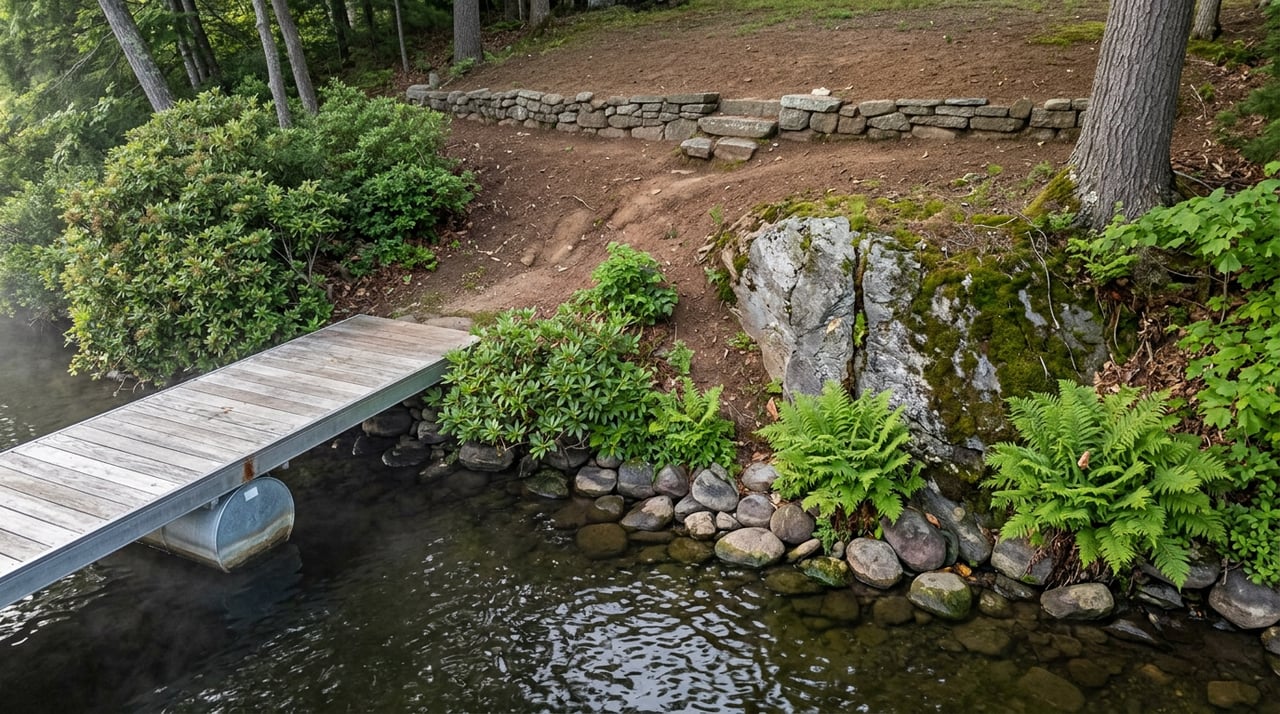
Here's the part that has nothing to do with the spillway and everything to do with how Lake Chatuge actually works. Every dock on the lake sits on TVA-controlled shoreline, and TVA permits are not real property. They do not convey with the house the way a fence or a driveway does.
| TVA Section 26a Basics | What It Means For You |
|---|---|
| Permits do not automatically transfer at sale | The new owner must apply separately, even for a dock that's decades old |
| Transfer window | Application due within 60 days of closing |
| Reissue fee | Typically $250 to transfer an existing permit |
| New construction fee | Typically $500 |
| Processing time | Up to 100 days, sometimes longer |
| Grandfathered docks | Facilities permitted before November 1, 1999 can remain if built to the original approved plan, but still require a transfer request at every ownership change |
| Covered second stories | Not allowed on new permits. If a listing shows an enclosed upper deck, ask whether it's compliant, because non-conforming structures are often required to come down |
The seller-side detail that catches people off guard is even simpler. TVA's own guidance states plainly that the existing permit must be in the current owner's name before the property changes hands cleanly. If a dock was built by a previous owner two sales ago and nobody filed the transfer paperwork along the way, you can inherit a permit gap that has nothing to do with the dock's condition and everything to do with a form that never got filed.
Separate from anything TVA decides about the dam, Lake Chatuge already swings roughly ten feet between full pool and winter pool every single year. Full pool sits at 1,928 feet above sea level. Winter pool runs about ten feet lower. That is normal, annual, and permanent, and it existed years before anyone proposed repairing the spillway.
The practical math is what buyers miss. A dock sitting in eight to ten feet of water at full pool in July may have only two to four feet under it by January. A dock in six feet of water at full pool can end up sitting on dry ground or in a puddle come winter. Docks in fifteen to twenty feet of water at full pool tend to stay comfortably navigable year round.
Where you sit on the lake changes how much this matters. Properties on the open main body near the dam and center of the reservoir generally keep meaningful depth through winter pool. Coves, especially in the upper Hiawassee arm, are a different story. Docks in shallow coves can end up stranded a hundred feet or more from the water's edge at the lowest winter levels.
None of the listing photos taken in July will show you this. If you're evaluating a cove property, ask the seller directly what the water depth is at the dock during winter pool, not full pool. If they don't know, a local dock service company can sound the depth in January or February before you remove your inspection contingency.
Will TVA drain Lake Chatuge this year? No. A final decision on which repair alternative to use isn't expected until early 2027, and construction wouldn't begin before late 2027 at the earliest, more likely 2028 or 2029.
Does my dock permit come with the house when I buy it? No. TVA requires the new owner to apply for a transfer within 60 days of closing, even on a dock that's been in place for decades.
What's the real difference between full pool and winter pool? About ten feet, every year, regardless of the dam project. It's the single biggest factor in whether your dock stays usable in January, and it's worth checking before you fall in love with a July listing photo.
Lake Chatuge sits across two states and two counties, and the questions that actually decide whether a waterfront closing goes smoothly rarely show up on a spec sheet. If you're weighing a purchase on either side of that line, Karyn Woody can walk the shoreline with you, pull the permit history, and tell you what a specific dock looks like in February, not just July. Request a free home valuation or schedule a consultation to get the local read before you write an offer.
As a full-time Real Estate Agent, wife, mom, and barrel racer, Karyn balances her dynamic life with a steady commitment to her clients. With Karyn, you get more than an agent—you get an advocate.