Georgia Doesn't Require A Disclosure Form. Your Private Road Still Does.
September 10, 2026
September 10, 2026
What do you actually owe a buyer when you sell a cabin outside Blairsville?
Most sellers assume the answer lives in a disclosure form, the same one their agent hands them at listing appointment, the one with the yes-or-no boxes about the roof and the HVAC. Georgia doesn't require that form. Never has. Sellers here operate under a buyer-beware standard, and plenty of closings go smoothly without a single disclosure document changing hands. Which is exactly why the thing that actually stops a Union County deal in its tracks rarely has anything to do with disclosure at all. It shows up three weeks later, buried in a loan file, on a private road nobody thought to check.
Georgia is a caveat emptor state. Sellers are not obligated by statute to complete a property disclosure statement, and plenty of cabin and land transactions in Union County close without one. What the law does require is narrower and easy to miss. Under Georgia Code Section 10-6A-5, a broker representing the seller has a duty to disclose all adverse material facts about the physical condition of the property to a buyer, and sellers must answer a buyer's direct questions honestly. Georgia's fair housing statute, Code Section 44-1-16, carves out the questions a seller isn't required to answer at all.
That's the whole legal floor. Honest answers when asked. A broker's duty to flag known defects. No mandatory form, no statewide checklist. Nolo's rundown of the statute lays out the same limits any Georgia seller would find in their own contract paperwork.
Sellers who understand this correctly conclude they have less paperwork to worry about than a friend selling in Florida or California. Where that confidence goes wrong is assuming the absence of a disclosure form means the absence of risk. It doesn't. It just means the risk moved somewhere else.
Picture two buyers making offers on the same Union County cabin, same road, same seller, same asking price. One buyer is financing with a conventional loan through Freddie Mac. The other is using a VA loan. Both offers look identical on paper. Only one of them is likely to close on schedule.
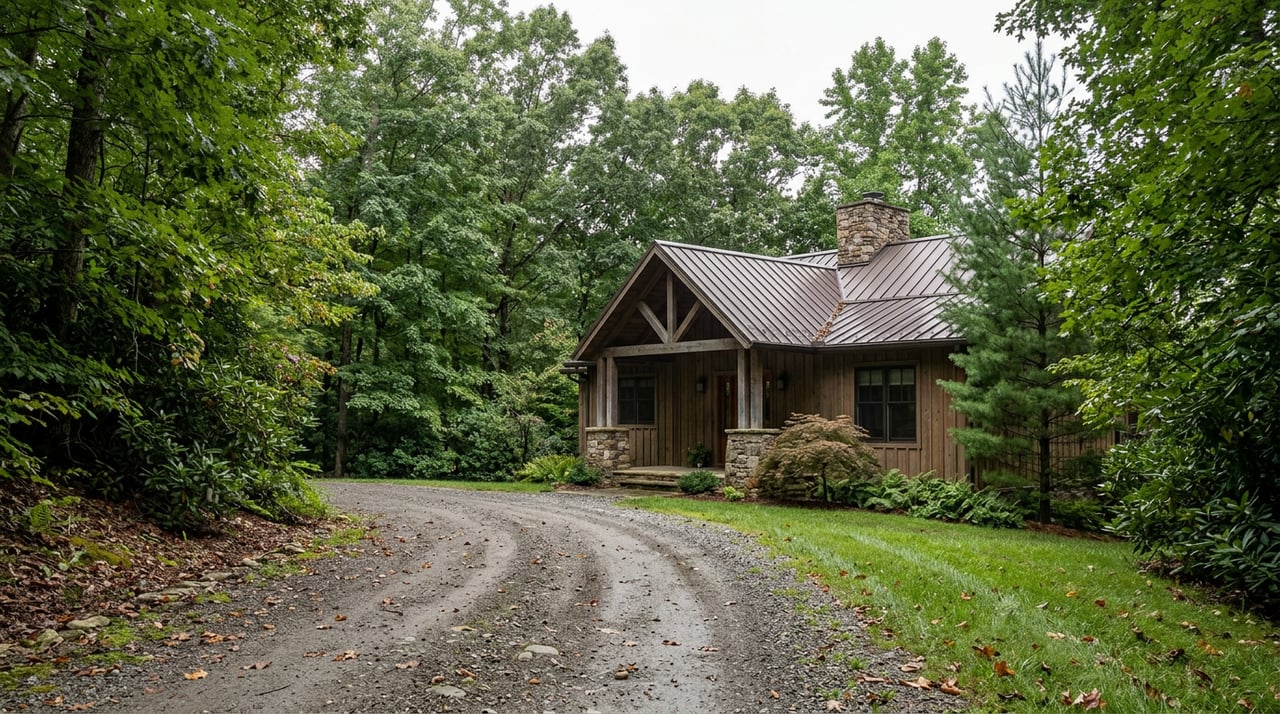
The difference is the road. A large share of cabins and acreage parcels around Blairsville sit on private roads shared with a handful of neighbors, roads the county never touches and never will. Whether that matters to a lender depends entirely on the loan type, and the variance is wide enough that most sellers have never heard of it until it shows up in their own file.
| Loan Type | Private Road Maintenance Agreement Required | What The Lender Actually Wants |
|---|---|---|
| VA | Yes | A signed, notarized agreement on record |
| USDA | Case by case | Determined during underwriting |
| FHA | No | A recorded road easement |
| Conventional (Freddie Mac) | No | Generally not required |
That table is the whole story in one place. A seller with no formal road agreement can close without friction on a conventional buyer and then watch the exact same house stall for weeks when a VA buyer's underwriter asks for a document that may not exist. It isn't a defect. It isn't dishonesty. It's a mismatch between what the house has and what one particular loan program requires, and it only surfaces once financing is underway, which is the worst possible time to discover it.
Mortgage industry guidance on private road financing confirms the pattern directly: some programs require a formal agreement, others will accept a recorded easement, and which one applies depends on the loan, not the property.
Where an agreement does exist, the terms are usually simple. Sample maintenance agreements used in similar rural subdivisions typically specify a modest annual due per lot, often in the low hundreds of dollars, collected once a year to cover grading and repairs. It's not a large sum. The problem was never the cost. It's that half the mountain properties around here never had the paperwork drawn up in the first place, because the road has worked fine for thirty years and nobody thought a document was necessary until a lender asked for one.
The road isn't the only place this pattern repeats. Most of the housing stock around Blairsville was built for full-time mountain living or long weekends, not subdivision uniformity, and that shows up in three recurring spots.
Wells and septic systems are the norm rather than the exception on acreage and cabin properties throughout Union County. A seller's duty to disclose a known problem with either system falls squarely under the material defect standard, so a documented water quality issue or a septic system on its last legs is something a seller has to answer honestly if asked. But routine maintenance history and system capacity aren't defects, they're just facts a buyer's lender will want documented before closing, and scrambling to produce a water test or septic inspection during underwriting costs time nobody budgeted for.
Unpermitted additions are the other repeat offender. A screened porch built without a permit twenty years ago rarely gets flagged during a casual walkthrough, but it surfaces during an appraisal or a title search, and once it does, it can complicate financing and insurance in ways that have nothing to do with whether the seller disclosed it honestly.
None of these are disclosure failures. They're documentation gaps that Georgia's buyer-beware law was never designed to catch, because the law governs what a seller has to say, not what a lender needs to see.
This isn't a hypothetical edge case for Union County. Land currently listed for sale here ranks among the higher totals of any county in Georgia, and within the county, Blairsville itself carries the largest share of those listings. A market this heavily weighted toward acreage and rural parcels, rather than subdivision homes on county-maintained streets, is a market where private roads, wells, and septic systems aren't occasional quirks. They're the baseline condition of the housing stock.
That's the real information gap for anyone selling or buying here. The disclosure conversation gets all the attention because it's the part every guide to Georgia real estate law covers. The financing-stage friction gets almost none, because it depends on loan type, county road classification, and paperwork that may or may not exist, none of which fits neatly into a generic disclosure checklist.
A few steps close this gap before it becomes a closing-day problem.
Does every buyer need a Private Road Maintenance Agreement? No. It depends entirely on the loan. VA financing requires one. Conventional loans through Freddie Mac generally don't. FHA and USDA fall somewhere in between, usually wanting a recorded easement instead.
What if there's no agreement and never has been? That's common on older mountain roads, and it isn't a violation of anything. It becomes a problem only when a specific loan program requires documentation that was never created, which is why checking early matters more than checking at all.
Does Georgia's disclosure law require me to mention that no agreement exists? Not as a matter of the disclosure statute, since no form is required in the first place. But if a buyer asks directly, Georgia law requires an honest answer, and a seller who already knows the situation is in a far better position to answer clearly and keep the deal moving.
Selling or buying acreage near Blairsville rewards the kind of local, ground-level knowledge that a generic closing checklist can't provide. Karyn Woody has spent decades working these exact properties and knows which paperwork questions to ask before a lender does. Request a free home valuation or schedule a consultation to get ahead of the friction before it shows up at underwriting.


As a full-time Real Estate Agent, wife, mom, and barrel racer, Karyn balances her dynamic life with a steady commitment to her clients. With Karyn, you get more than an agent—you get an advocate.