Lake Chatuge's State Line Doesn't Touch Your Dock. It Rewrites Your Contract.
September 3, 2026
September 3, 2026
A couple stood on a dock last spring looking across a narrow cove on Lake Chatuge at a house they'd toured that same morning. Same rock shoreline. Same view of the ridgeline behind Brasstown Bald. Same builder-grade dock hardware, probably installed by the same handful of contractors who work this lake. The only thing separating the two properties was about four hundred feet of water and an invisible line that happens to be the border between Georgia and North Carolina.
What surprised them wasn't the geography. Plenty of people know Chatuge sits in two states. What surprised them was learning that the contract they'd sign to buy one house works nothing like the contract they'd sign for the other, while the rules governing the thing they actually cared about, the dock itself, turned out to be identical on both sides.
That's the part worth understanding before you fall for a house on either shore. The state line on Lake Chatuge changes less than you'd expect where you'd expect it to matter, and more than you'd expect where nobody thinks to look.
Lake Chatuge was built by the Tennessee Valley Authority in the early 1940s, and the reservoir it created sits in Towns County, Georgia on one side and Clay County, North Carolina on the other. Hiawassee and Young Harris anchor the Georgia shoreline. Hayesville anchors the North Carolina side, just north of Chatuge Dam. Anyone shopping this lake with an open mind about which shore to land on is, functionally, shopping two different states at once, and that has consequences that show up long before you ever get to the dock.
Here's the part that catches people off guard. Georgia and North Carolina solve the same problem, giving a buyer time to inspect a house without giving up their deposit, using two genuinely different mechanisms.
On the Georgia side, the standard contract is the GAR Purchase and Sale Agreement, and it works on a single due diligence period, commonly seven to fourteen days from the binding agreement date. During that window a buyer can terminate for any reason, or no reason, and get the earnest money back in full. Miss the deadline and the leverage flips. There's no separate payment required to buy that window. The earnest money itself is what's at stake.
North Carolina runs it differently. The standard Form 2-T splits the protection into two payments instead of one. A due diligence fee goes directly to the seller at signing, and it is not refundable if the buyer walks away, except in narrow cases like a seller's material breach. That fee buys the seller's certainty that the house is off the market. Earnest money, held separately in escrow, is what actually comes back to the buyer if they terminate on time. Close the deal, and the due diligence fee gets credited toward the purchase price just like earnest money does.
Both states are solving the identical problem: how does a seller get comfortable taking their house off the market for two weeks while a buyer pokes around the crawl space. Georgia solves it by putting the buyer's own deposit on the line. North Carolina solves it by requiring a separate, nonrefundable payment as a costly signal of seriousness. Neither is more protective of buyers or sellers in the abstract. They're just different technologies built to answer the same incentive problem, and a buyer who doesn't know which one they're operating under can misjudge how much room they actually have to change their mind.
| Georgia (Towns County) | North Carolina (Clay County) | |
|---|---|---|
| Buyer's protection | Due diligence period, typically 7-14 days | Due diligence fee plus separate due diligence period, often two weeks to a month |
| What's refundable | Earnest money, if terminated on time | Earnest money only; due diligence fee is not refundable |
| Closing requirement | Licensed Georgia attorney must conduct closing | Licensed North Carolina attorney must conduct closing |
| Attorney fee, typical | Roughly $500 to $800 | Roughly $500 to $800 |
| State transfer tax | $0.10 per $100 of sale price | $1 per $500 of sale price (equivalent to $2 per $1,000) |
Both states require a licensed attorney to conduct the closing itself. Neither Georgia nor North Carolina lets a title company alone finish the job the way Florida or Texas does, so the attorney line item on your settlement statement isn't the differentiator. Fees on both shores tend to land in the same range, roughly $500 to $800 for a standard residential transaction.
Where the numbers actually diverge is the transfer tax. Georgia charges $0.10 per $100 of sale price, a rate low enough that it barely registers. North Carolina charges $1 per $500, which works out to $2 per $1,000, twice the effective rate. Run a $600,000 lake house through each formula and Georgia's tax comes to $600. North Carolina's comes to $1,200. In both states custom puts this cost on the seller's side of the ledger, and it's negotiable in both, but a seller pricing a comparable house on the North Carolina shore is carrying a heavier fixed cost at the closing table than a seller on the Georgia side, and that math is worth knowing before you set an asking price or negotiate who covers it.
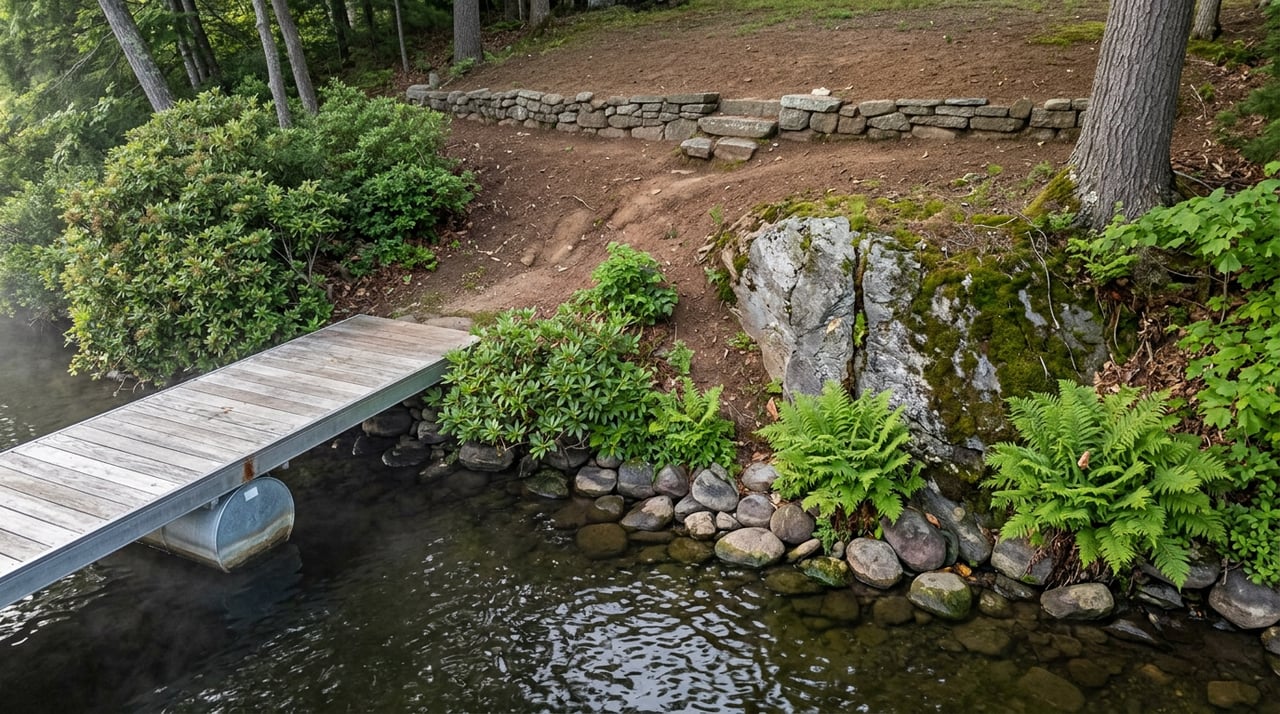
After walking through all of that, the part most buyers assume will be the complicated piece turns out to be the simple one. The dock itself answers to neither state. Lake Chatuge is TVA-managed on both shorelines, and TVA, not Georgia's Department of Natural Resources and not North Carolina's Wildlife Resources Commission, is the authority that issues the shoreline construction permit for a private dock. Contractors who work the lake regularly describe filing the same TVA permit application whether the property sits in Towns County or Clay County, layering county-level compliance on top where each county requires it, but working from one federal permitting system underneath both.
That's a real point of relief for buyers weighing the two shores. Whatever you've heard about dock rules varying wildly by state doesn't apply here the way it might on a lake split between two power companies. The authority that decides whether your dock design is approvable is the same authority no matter which side of the cove you buy on. What you should still verify at closing, on either shore, is that the seller's existing dock permit actually transfers with the property, since TVA permits are tied to specific structures and specific owners rather than automatically following a deed.
Georgia and North Carolina have a standing reciprocal agreement that lets a valid fishing license from either state cover you on Lake Chatuge and its boat-accessible tributaries. Senior citizen and youth exemptions from either state are honored on both sides too. For a buyer who pictures years of casual fishing off the back of a pontoon boat, that reciprocity removes one more thing to think about.
There's a specific carve-out worth knowing if fishing off your own dock is part of the appeal, though. The reciprocal agreement only covers boats that aren't anchored to the shore or tied to a pier or dock connected to the shore. Fish from your own dock, and you need the license for whichever state that dock physically sits in, not whichever license happens to be in your tackle box.
One more wrinkle is specific to this lake rather than either state as a whole. On the North Carolina side, Clay County's stretch of Chatuge carries its own bass regulation: a daily creel limit of ten fish in aggregate across largemouth, smallmouth, Alabama, and spotted bass, with a twelve-inch minimum size on largemouth, distinct from the fourteen-inch minimum that applies in some other North Carolina waters. It's a small detail, but it's the kind of thing a longtime lake resident would mention over coffee and a portal listing never will.
None of this settles the question of Georgia versus North Carolina for you. It reframes the question. The lake itself, the dock rules, and the fishing don't much care which shore you choose. What actually differs is the paperwork you sign on your way to owning the house, the sequence of payments you make while you're deciding whether to keep it, and the tax line at the closing table. Those are the variables worth running through your own numbers before you write an offer, not the water.
Does buying on one side mean working with a different agent than the other side? Not if your agent holds licenses in both states. A cross-licensed agent can walk you through a Georgia GAR contract on a Monday and a North Carolina Form 2-T on a Tuesday without handing you off to someone else mid-search.
If I pay a North Carolina due diligence fee and then decide I like a Georgia house better, do I lose that money? Generally yes. The fee is paid to the seller at signing and is not refundable if you walk away for a reason other than the seller's material breach. If you're seriously comparing shores, it's worth sequencing which offer you make first.
Does my Georgia fishing license cover me if I'm sitting on my North Carolina dock? Only from a boat that isn't tied to the shore or a dock. Fishing directly off a dock attached to North Carolina soil requires a North Carolina license, regardless of what state issued the license in your wallet.
If you're weighing a house on the Towns County shore against one in Clay County, or you just want someone who can explain what a due diligence fee actually protects before you sign one, Karyn Woody has spent two decades working both sides of this exact line. Reach out for a free home valuation or to schedule a consultation before your next showing.

As a full-time Real Estate Agent, wife, mom, and barrel racer, Karyn balances her dynamic life with a steady commitment to her clients. With Karyn, you get more than an agent—you get an advocate.